
Tailor Square Apartments
Rochester, NY
Owner: Home Leasing | Location: Rochester, NY
Architect: SWBR | Construction Manager: Home Leasing Construction
Completion Date: 2024
Project Overview
Tailor Square Apartments is a large-scale adaptive reuse project in Rochester, NY, transforming the historic Hickey Freeman manufacturing facility into a mixed- use community that combines affordable housing with ongoing industrial operations.
The redevelopment delivers 134 affordable senior housing units within a 232,000-square-foot structure while maintaining approximately 77,000 square feet of active manufacturing space and preserving more than 200 jobs.
Originally constructed for garment manufacturing, the building had long served as a major employment center in the region. The project repositions the structure to meet current housing needs while preserving its role as an active place of work.
The residential portion of the building is fully electric and supported by a comprehensive energy strategy, including geothermal heating and cooling and rooftop solar.
The redevelopment is further supported by the New York State Homes and Community Renewal Clean Energy Initiative (CEI), including a $1.675 million award to advance decarbonization and efficiency measures.
Project Highlights
Historic adaptive reuse
134-unit affordable senior housing (55+) • 134-unit affordable senior housing (55+)
Mixed-use with active manufacturing • Mixed-use with active manufacturing
90+ well geothermal system • 90+ well geothermal system
288 kW rooftop solar array • 288 kW rooftop solar array
$1.675M Clean Energy Initiative (CEI) funding
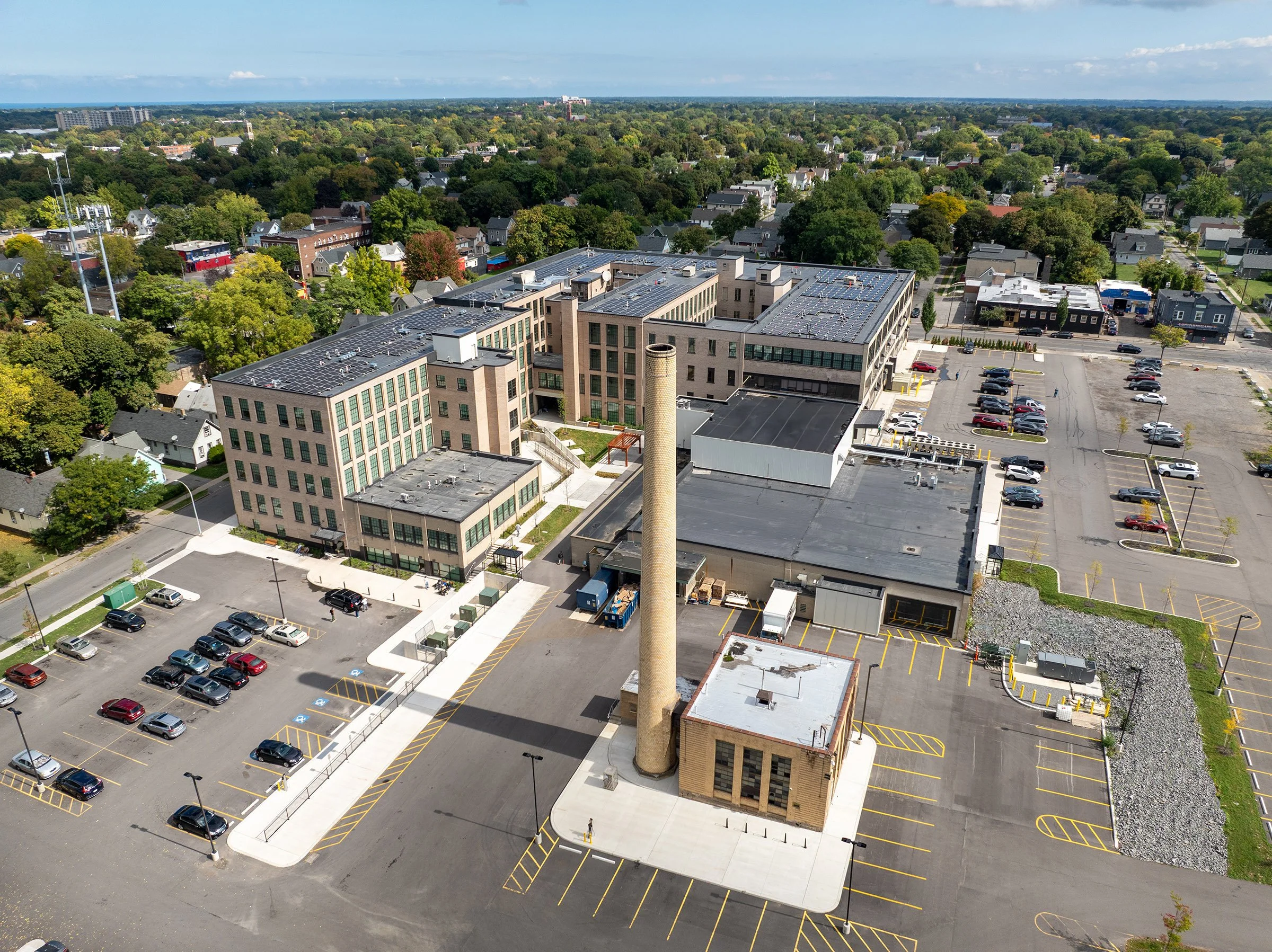
Aerial view of Tailor Square, a historic manufacturing facility redeveloped into affordable housing while maintaining active industrial operations.
Photo courtesy of SWBR
The Challenge
Tailor Square presented a unique level of complexity, combining adaptive reuse, decarbonization, and mixed-use conditions within a single building. A key challenge was balancing the requirements of the State Historic Preservation Office with Energy Star performance targets and best practices for insulating historic masonry walls.
The project ultimately became a strong example of collaboration across the design team, requiring close coordination to align preservation goals, performance standards, and constructability.
In addition to working within an existing masonry structure, the project required integrating new residential systems alongside an actively operating manufacturing facility on site. All work was completed while maintaining ongoing operations, requiring careful coordination to avoid disruption while introducing new systems and infrastructure into the building.
This overlap introduced challenges around system separation, ventilation, phasing, and coordination between uses. At the same time, the project aimed to significantly reduce energy use and carbon impact through electrification and high-performance upgrades.
The project also required environmental review and coordination typical of large-scale adaptive reuse, including hazardous material assessment, site constraints, and adjacency to active industrial uses.
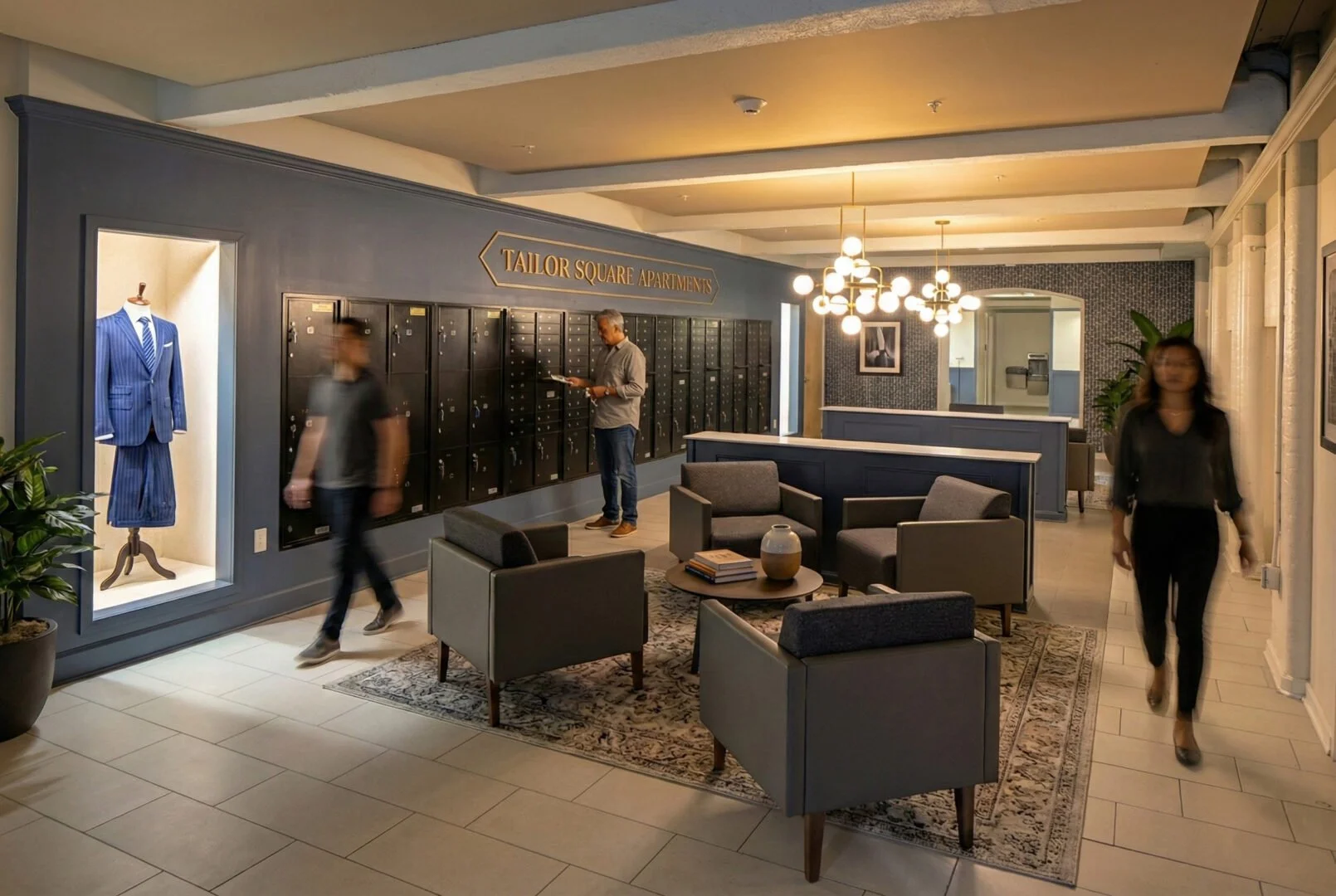
Shared spaces at Tailor Square support day-to-day living while maintaining the building’s historic character. Photo courtesy of SWBR
Sustainable Comfort’s Role
Sustainable Comfort served as the project’s energy efficiency and green building consultant, supporting the development and execution of the building’s performance strategy from early design through construction.
Energy Modeling and System Strategy
SCI conducted detailed energy modeling to evaluate system options and guide decisions around electrification, geothermal integration, and envelope improvements. This work established a clear path toward reducing energy use while maintaining feasibility within the project’s constraints.
Clean Energy Incentive Facilitation
SCI played a key role in securing $1.675 million in CEI funding, supporting the implementation of the project’s geothermal system and related efficiency upgrades. This funding was critical in enabling the project’s decarbonization strategy.
On-Site Verification and Coordination On-Site Verification and Coordination Throughout construction, SCI conducted site inspections and testing to confirm that systems were installed and performing as intended. They worked closely with the project team to address issues as they arose, ensuring alignment between design intent and field conditions.
Building Performance Strategy
The project centers on a transition to all-electric systems within an existing structure, anchored by a geothermal heating and cooling system serving the residential portion of the building.
The system includes approximately 90+ geothermal wells, each reaching depths of roughly 495 feet, making it one of the largest installations of its kind in the region.
The residential portion is fully electric and supported by a 288 kW rooftop solar array, offsetting a significant portion of building energy use and reducing reliance on the grid.
Additional performance upgrades include:
• Central energy recovery ventilation
• Improved roof and wall insulation
• High-performance window replacements aligned with historic requirements
Together, these measures create a comprehensive approach to reducing energy demand while improving comfort, durability, and long-term building performance.
Results

Residential units at Tailor Square feature large industrial windows, high ceilings, and modern systems within the historic structure.
Photo courtesy of SWBR
Tailor Square demonstrates how large-scale adaptive reuse can support housing, economic continuity, and decarbonization within a single development.
The project delivers affordable senior housing while maintaining active manufacturing operations, preserving jobs and reinforcing the building’s long-standing role in the community. From a performance standpoint, geothermal systems, electrification, and envelope improvements reduce energy use and long-term operating costs while improving indoor comfort.
The design maintains the building’s industrial character, with large windows, high ceilings, and shared spaces that support accessibility and community for senior residents.
For Sustainable Comfort, the project highlights the impact of early-stage energy strategy and incentive coordination. By aligning technical design with available funding, SCI helped make a high-performance, all-electric approach both achievable and practical at scale.